
How Plumbing Businesses Lose Thousands in Missed Leads (And How to Fix It)
Missed calls, unread website enquiries, and forgotten follow-ups could be costing your plumbing business thousands every month. Discover how a simple lead management system helps capture more jobs without hiring extra staff.
How to Stop Losing Plumbing Leads and Get More Jobs (Without Extra Staff)
Your phone rings at 2pm on a Tuesday. Your best technician is elbow-deep in a boiler replacement in Manchester 2 or a bathroom refit in Austin. The call goes to voicemail. You plan to call back after the job wraps up.
By 4pm, that homeowner has already booked someone else.
This is not a pricing problem. It is not a skills problem. It is a response problem. And it is quietly costing small plumbing businesses thousands every single month - not from bad jobs, but from good leads that simply did not get a fast enough reply.
You Are Probably Busier Than You Think - And Still Losing Jobs
Think about last week. How many calls came in while your team was on site? How many contact form submissions landed in an inbox that nobody opened until the following morning? How many homeowners left a voicemail, did not hear back within the hour, and booked the next plumber on the list?
Every single one of those was a real job - with a real budget, a real problem that needed fixing, and a real willingness to pay. They did not go to a better plumber. They went to the plumber who picked up first.
The frustrating part is that none of this shows up anywhere. There is no "lost lead" notification. The missed call just sits in voicemail. The form submission quietly ages in an inbox. The job gets booked by someone else and you never even knew it was available.
The Hidden Cost Nobody Calculates
Most plumbing business owners know they miss some leads. What they rarely do is put an actual number on it.
Try this. Take the average value of a job in your business - in the UK, a standard call-out and repair typically runs between £180 and £500. In the US, between $250 and $700. Now think about how many enquiries per week do not turn into booked jobs.
If you are receiving 20 enquiries a week and converting 12, you are losing 8. At an average of £300 per job, that is £2,400 every week. Over a year, that is £124,800 - not from a bad month, not from a slow season, but from leads that already found you and then quietly booked someone else.
That number tends to change how urgently people want to fix the problem.
Where Leads Actually Disappear
The interesting thing about lost plumbing leads is that they rarely disappear dramatically. There is no single moment of failure. They just quietly go cold - and by the time anyone notices, the customer has already moved on.
The most common place is the missed call. A technician is mid-job. The phone rings in the van. It goes to voicemail. The customer hangs up and dials the next number on the list. By the time the call gets returned two hours later, the job is gone.
The second is the website form that nobody sees until it is too late. Most enquiries submitted after 6pm are not read until the following morning. By then, the customer has already had a conversation with a competitor who happened to check their notifications before bed.
The third - and the one most business owners underestimate - is the lead that said not yet. A customer gets a quote, is not quite ready to commit, and gets put in the mental "I will follow up on that" pile. A week passes. Then two. The customer never hears back, assumes the plumber is not interested, and calls someone else. That job was won and then lost without the business owner ever realising it.
The Fix Is Not Another Staff Member
The instinct when leads are slipping is to hire. Get someone to answer the phone. Get someone to check the emails. Get a receptionist.
The problem with that thinking is that a full-time receptionist costs between $2,500 and $4,000 per month in the US, or £1,800 to £2,800 per month in the UK. And a person can still miss calls, still overlook a form submission, still forget to follow up on a quote from ten days ago.
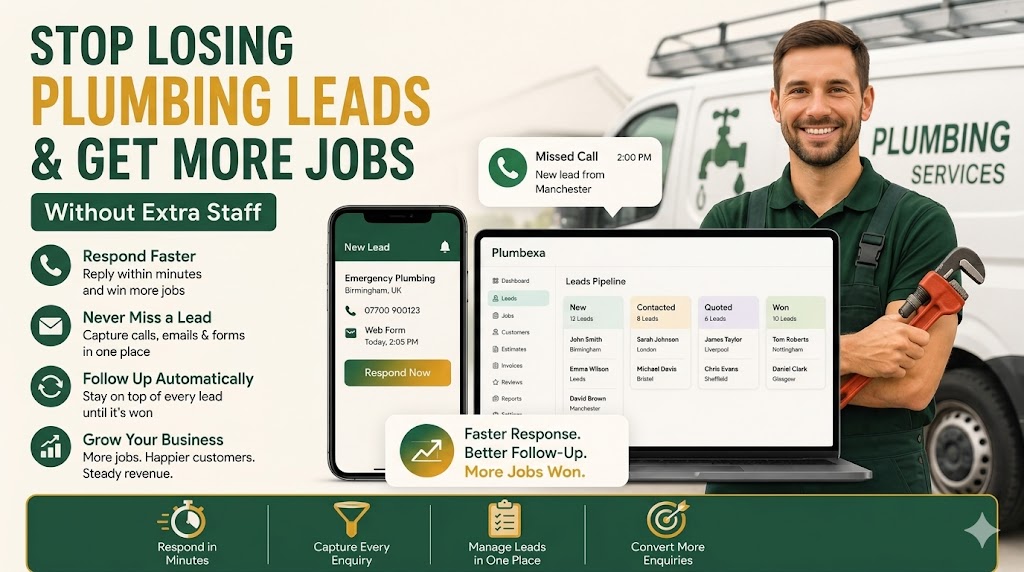
What actually fixes a plumbing lead conversion problem is a pipeline - a single place where every enquiry lands, gets a status, and stays visible until it becomes a booked job or a confirmed lost lead.
When a new enquiry arrives, it shows up immediately with a New status. Someone contacts the lead and moves it to Contacted. An estimate goes out and it becomes Quoted. If the customer goes quiet, it stays in view with a follow-up reminder rather than disappearing into an email thread. Nothing gets forgotten because nothing is stored in anyone's head.
That is not a complicated system. It is just one place where everything lives, so the gaps that currently swallow leads simply stop existing.
Response Time Is a Competitive Advantage Most Plumbers Are Ignoring
In a market where most plumbing businesses respond to enquiries in three to six hours, responding in under 15 minutes is not just good service - it is a genuine edge.
Customers making urgent booking decisions are not waiting around. They are sending enquiries to multiple businesses simultaneously and booking the first credible response. A business that consistently responds within 15 minutes will win a disproportionate share of those jobs compared to competitors who are equally good at the actual work but slower to reply.
This does not require someone sitting next to a phone all day. It requires a notification the moment a new lead arrives - on a phone, a tablet, wherever the person who handles bookings happens to be - so that a quick reply goes out before the customer has finished browsing the next result on the page.
What Happens When the System Works
When every enquiry lands in a visible pipeline, three things change quickly.
Conversion rate goes up because leads stop going cold between the enquiry and the estimate. Response time drops because notifications replace inbox-checking. And follow-up actually happens - not because anyone has to remember, but because the system flags it automatically when a quoted lead has not responded in a set number of days.
Plumbexa is built specifically for this - a single dashboard where plumbing businesses in the US and UK manage leads, jobs, estimates, invoices, and review requests without switching between apps or relying on memory. The Starter plan begins at $29/month for small teams, with Pro at $79/month for teams of up to 10. No credit card is needed to start.
Frequently Asked Questions
Q1. Why do plumbing businesses lose leads even when they are busy?
Busy means jobs are happening - not that enquiries are being caught. Leads slip through missed calls, unread forms, and forgotten follow-ups. A visible pipeline where every enquiry has a status and a next action stops this without adding workload.
Q2. How quickly should a plumbing business respond to a new enquiry?
Within 15 minutes where possible. Most homeowners contact two or three businesses at once and book the first credible response. In a market where the average response time is several hours, replying in minutes wins a significant share of jobs purely on speed.
Q3. What is the best follow-up approach for a lead that has not responded to a quote?
A short, friendly message two to three days after the estimate - not a sales pitch, just a check-in. Most undecided customers book on a single follow-up that competitors never bothered to send.
Q4. Is there a simple way to track plumbing leads without a complex CRM?
A five-status pipeline - New, Contacted, Quoted, Won, Lost - covers the entire process. The key is that every lead is inside the system, not sitting in a WhatsApp message or a notebook in the van.
Q5. Can lead conversion improve without hiring extra staff?
Almost always yes. A system that captures every enquiry and flags follow-ups costs far less than a receptionist and works consistently across every lead - including the ones that arrive at 9pm on a Sunday.
Plumbexa helps small plumbing businesses in the US and UK capture every lead, follow up without the chasing, and convert more enquiries into paid jobs. Start free - no credit card required.
Grow your plumbing business with Plumbexa
Leads, scheduling, estimates, and invoices in one place.